Wildlife
19 species from the app’s field log, with the photo and the Wikipedia extract it quotes.
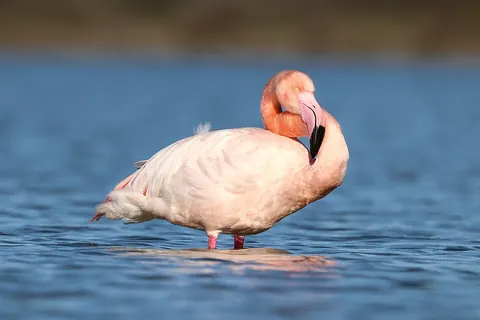
Photo : Alexandre Benbrik, CC BY-SA 4.0 Greater flamingo
The greater flamingo is the largest and most widespread species of the flamingo family. Common in the Old World, they are found in Northern (coastal) and Sub-Saharan Africa, the Indian subcontinent, Central Asia, the Middle East, the Levant, the Persian Gulf, the Gulf of Aden, the Red Sea, and the Mediterranean countries of Southern Europe.
Wikipedia: Greater flamingo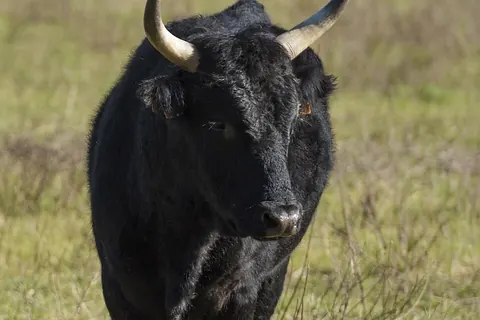
Photo : Christian Ferrer, CC BY-SA 4.0 Camargue bull
The Raço di Biòu is a French breed of domestic cattle native to the Camargue marshlands of the river delta of the Rhône in southern France. It is used for the traditional sport of course camarguaise, a kind of bloodless bull-fight, but not for the corrida, Iberian-style bull-fighting. It is one of two cattle breeds raised in semi-feral conditions in the Camargue; the other is the Brava or Race de Combat, a fighting breed. It was formerly known as the Camargue or Race Camarguaise; since 1996 it has been officially known by its Provençal name.
Wikipedia: Raço di Biòu
Photo : Rambouil jean, CC BY-SA 4.0 Camargue horse
The Camargue or French: Cheval de Camargue, Occitan: Caval de Camarga or Camargués, is a traditional French breed of working horse indigenous to the Camargue wetlands in the département of Bouches-du-Rhône, in southern France. Its origins are unknown.
Wikipedia: Camargue horse
Photo : El Golli Mohamed, CC BY-SA 4.0 Little egret
The little egret is a species of small heron in the family Ardeidae. It is a white bird with a slender black beak, long black legs and, in the western race, yellow feet. As an aquatic bird, it feeds in shallow water and on land, consuming a variety of small creatures. It breeds colonially, often with other species of water birds, making a platform nest of sticks in a tree, bush or reed bed. A clutch of three to five bluish-green eggs is laid and incubated by both parents for about three weeks. The young fledge at about six weeks of age.
Wikipedia: Little egret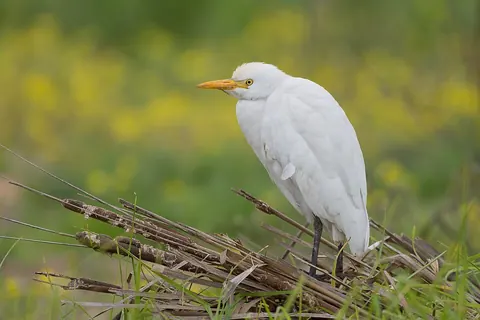
Photo : El Golli Mohamed, CC BY-SA 4.0 Western cattle egret
The western cattle egret is a species of heron found in the tropics, subtropics and warm temperate zones. Formerly, most taxonomic authorities lumped this species and the eastern cattle egret together, but the two cattle egrets are now treated as separate species. Despite the similarities in plumage to the egrets of the genus Egretta, it is more closely related to the herons of Ardea. Originally native to parts of Africa, southwest Asia and southern Europe, it has undergone a rapid expansion in its distribution and successfully colonised much of the New World in the last century.
Wikipedia: Western cattle egret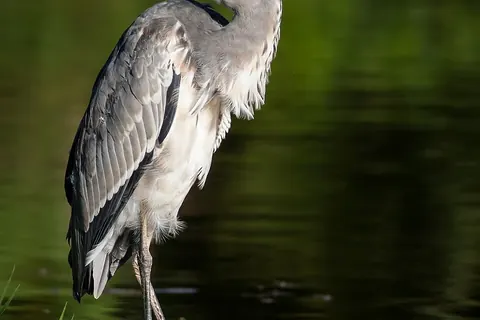
Photo : Laitche, CC BY-SA 3.0 Grey heron
The grey heron is a long-legged wading bird of the heron family, Ardeidae, native throughout Europe, Asia, and most of Africa. It is resident in much of its range, but some populations from the more northern parts migrate southwards in autumn. A bird of wetland areas, it can be seen around lakes, rivers, ponds, marshes and on the sea coast. It feeds mostly on aquatic creatures which it catches after standing stationary beside or in the water, or stalking its prey through the shallows.
Wikipedia: Grey heron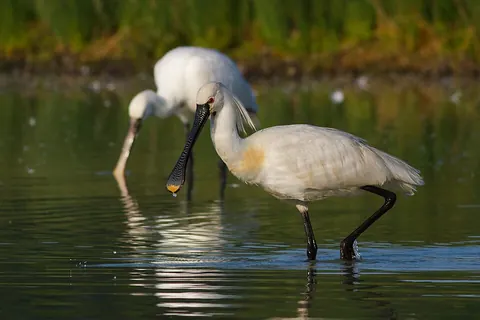
Photo : Pierre Dalous Camera location43° 15′ 38.8″ N, 1° 39′ 44.7″ E View this and other nearby images on: OpenStreetMap 43.260778; 1.662417, CC BY-SA 3.0 Eurasian spoonbill
The Eurasian spoonbill, or common spoonbill, is a wading bird of the ibis and spoonbill family Threskiornithidae, native to Europe, Africa and Asia. The species is partially migratory with the more northerly breeding populations mostly migrating south for the winter.
Wikipedia: Eurasian spoonbill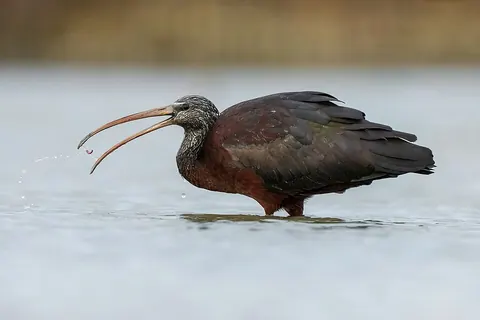
Photo : Giles Laurent, CC BY-SA 4.0 Glossy ibis
The glossy ibis is a water bird in the order Pelecaniformes and the ibis and spoonbill family Threskiornithidae. The scientific name derives from Ancient Greek plegados and Latin, falcis, both meaning "sickle" and referring to the distinctive shape of the bill.
Wikipedia: Glossy ibis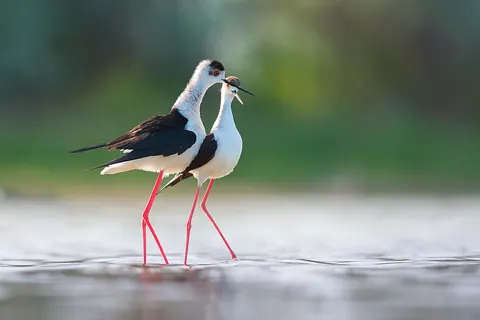
Photo : Ryzhkov Sergey, CC BY-SA 4.0 Black-winged stilt
The black-winged stilt is a widely distributed, very long-legged wader in the avocet and stilt family Recurvirostridae. Its scientific name, Himantopus himantopus, is sometimes used to generalize a single, almost cosmopolitan species. Alternatively, it is restricted to the form that is widespread in Europe, Asia and Africa, which equals the nominate group of H. himantopus sensu lato. Meanwhile, the black-necked and white-backed stilts both inhabit the Americas; the pied stilt ranges from Australia and New Zealand. Today, most sources accept between one and four actual species.
Wikipedia: Black-winged stilt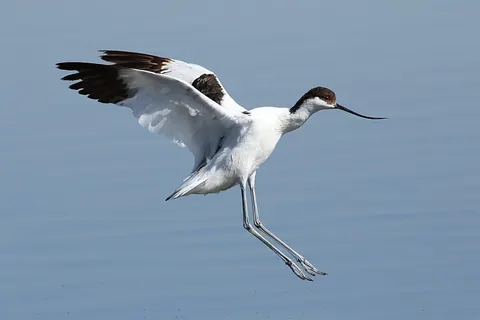
Photo : Derek Keats from Johannesburg, South Africa, CC BY 2.0 Pied avocet
The pied avocet is a species of wader in the Recurvirostridae family, the only member of the avocet genus Recurvirostra found in Europe, Africa, and Asia.
Wikipedia: Pied avocet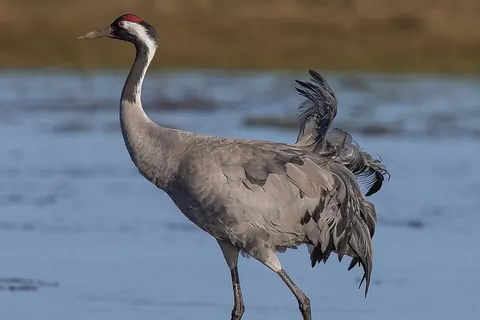
Photo : Andreas Trepte, CC BY-SA 2.5 Common crane
The common crane, also known as the Eurasian crane, is a bird of the family Gruidae, the cranes. A medium-sized species, it is the only crane commonly found in Europe besides the demoiselle crane and the Siberian crane that only are regular in the far eastern part of the continent. Along with the sandhill crane, demoiselle crane and the brolga, it is one of only four crane species not currently classified as threatened with extinction or conservation dependent on the species level. Despite the species’ large numbers, local extinctions and extirpations have taken place in part of its range, and an ongoing reintroduction project is underway in the United Kingdom.
Wikipedia: Common crane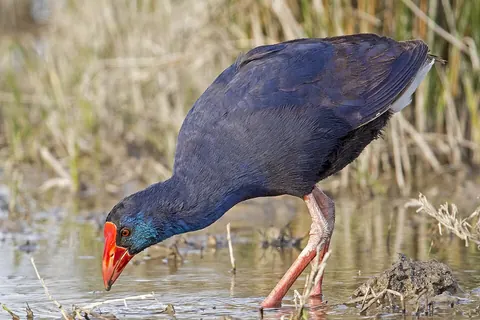
Photo : Andreas Trepte, CC BY-SA 4.0 Western swamphen
The western swamphen is a species of swamphen in the rail family Rallidae, one of the six species of purple swamphen. This chicken-sized bird, with its large feet, bright plumage and red bill and frontal shield is easily recognisable in its native range. It used to be considered the nominate subspecies of the purple swamphen, but is now recognised as a separate species. The western swamphen is found in wetlands in Spain, Portugal, southeastern France, Italy and northwestern Africa.
Wikipedia: Western swamphen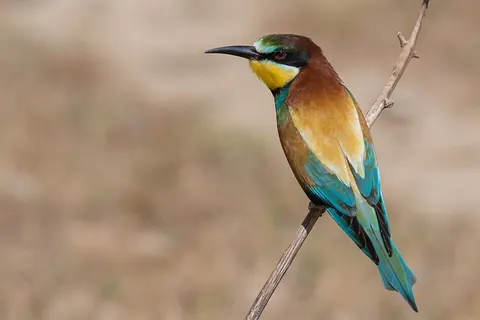
Photo : El Golli Mohamed, CC BY-SA 4.0 European bee-eater
The European bee-eater is a bird species in the bee-eater family, Meropidae. It has the largest range of any bee-eater species, breeding in southern and central Europe, northern and southern Africa, and western Asia. Except for the resident southern African population, the species is strongly migratory, wintering in tropical Africa. This species occurs as a spring overshoot north of its usual range, with occasional breeding in northern Europe.
Wikipedia: European bee-eater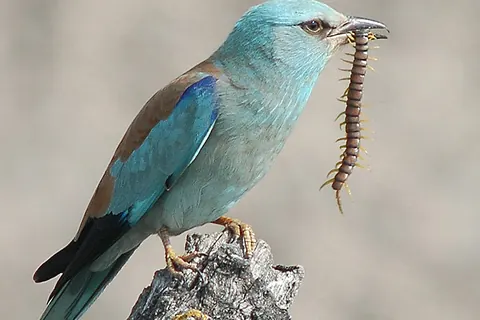
Photo : Christian Svane, CC BY-SA 2.5 European roller
The European roller is the only member of the roller family Coraciidae breeding in Europe. Its range extends into the Maghreb, West Asia and Central Asia. It winters in southern Africa, primarily in dry wooded savanna and bushy plains. It occurs in a wide variety of habitats, but avoids treeless plains. It usually nests in tree holes.
Wikipedia: European roller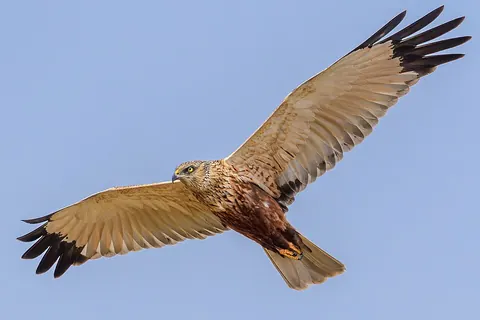
Photo : Stephan Sprinz, CC BY 4.0 Western marsh harrier
The western marsh harrier is a large harrier, a bird of prey from temperate and subtropical western Eurasia and adjacent Africa. It is also known as the Eurasian marsh harrier. Formerly, a number of relatives were included in C. aeruginosus, which was then known as "marsh harrier". The related taxa are now generally considered to be separate species: the eastern marsh harrier, the Papuan harrier of eastern Asia and the Wallacea, the swamp harrier of Australasia and the Madagascar marsh harrier of the western Indian Ocean islands.
Wikipedia: Western marsh harrier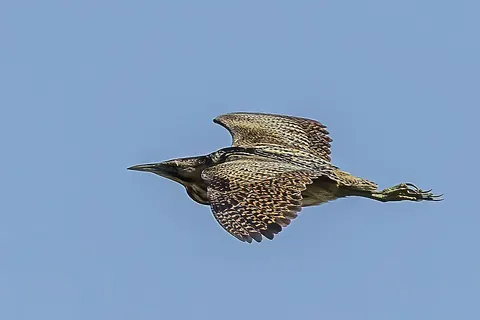
Photo : Charles J. Sharp, CC BY-SA 4.0 Eurasian bittern
The Eurasian bittern or great bittern is a wading bird in the bittern subfamily (Botaurinae) of the heron family Ardeidae. There are two subspecies, the northern race breeding in parts of Europe and across the Palearctic, as well as on the northern coast of Africa, while the southern race is endemic to parts of southern Africa. It is a secretive bird, seldom seen in the open as it prefers to skulk in reed beds and thick vegetation near water bodies. Its presence is apparent in the spring, when the booming call of the male during the breeding season can be heard. It feeds on fish, small mammals, fledgling birds, amphibians, crustaceans and insects.
Wikipedia: Eurasian bittern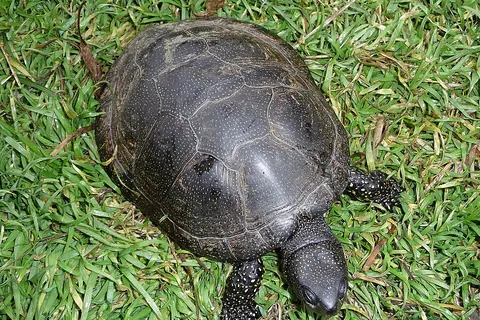
Photo : George Chernilevsky, Public domain European pond turtle
The European pond turtle, also called commonly the European pond terrapin and the European pond tortoise, is a species of long-living freshwater turtle in the family Emydidae. The species is endemic to the Western Palearctic.
Wikipedia: European pond turtle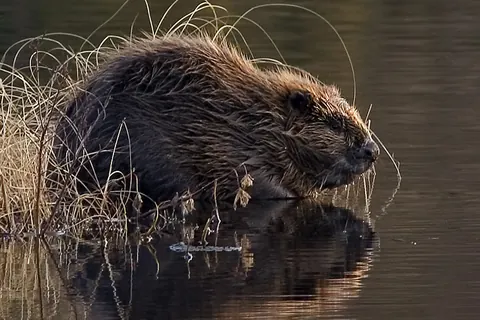
Photo : Per Harald Olsen, CC BY-SA 3.0 Eurasian beaver
The Eurasian beaver or European beaver is a species of beaver widespread across Eurasia, with a rapidly increasing population of 1.5 million in 2020. The Eurasian beaver was hunted to near-extinction for both its fur and castoreum, with only about 1,200 beavers in eight relict populations from France to Mongolia in the early 20th century. It has since been reintroduced into much of its former range and now lives from Western, Southern, Central and Eastern Europe, Scandinavia, Russia through China and Mongolia, with about half the population in Russia. It is listed as least concern on the IUCN Red List.
Wikipedia: Eurasian beaver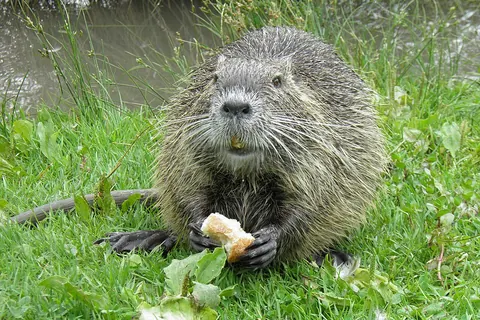
Photo : Gzen92, CC BY-SA 4.0 Nutria
The nutria or coypu is an herbivorous, semiaquatic rodent native to South America.
Wikipedia: Nutria


